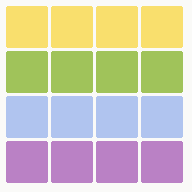
NYT Connections Hints, Answers & Clues -
NYT Connections #1199 Tip
One category is hiding in plain sight behind missing punctuation.
What Makes NYT Connections #1199 Tricky?
Words like FLOURISH, ACCENT, ROSE, and THE sit in the same grid — a scatter of grammar terms, survey language, decorative words, and what looks like a definite article.
The editor's sleight of hand is that several words look completely unremarkable in English but are actually foreign-language drink names with their diacritical marks quietly removed.
Two groups are approachable once you spot the theme, but the purple category in particular will stump anyone who reads THE as an article and moves on without a second thought.
Connections Hints for Every Word in the September 22, 2026 Puzzle
THIS
Connections hint for THIS
A demonstrative word used to point to something nearby — here it is functioning as a grammatical pointer, not a filler word.
THAT
Connections hint for THAT
A demonstrative word pointing to something more distant — one of the four English demonstratives, not a conjunction.
THE
Connections hint for THE
Looks like the definite article, the most common word in English — but here it is a French herbal liqueur with an accent grave over the E: Thé.
OTHER
Connections hint for OTHER
On a survey form, OTHER is the catch-all option for respondents who do not fit any listed choice.
CAFE
Connections hint for CAFE
Looks like a coffee shop — but without its accent it is hiding CAFÉ, the coffee-based drink.
PATRON
Connections hint for PATRON
Looks like a regular customer or a sponsor — but without its accent it is PATRÓN, the well-known tequila brand.
AGREE
Connections hint for AGREE
A standard survey response option — you select this when you agree with a statement on a Likert scale.
ACCENT
Connections hint for ACCENT
Not about pronunciation here — an accent is a small decorative touch added to enhance something, like an accent wall or an accent colour.
TOUCH
Connections hint for TOUCH
Not physical contact — a touch is a small finishing detail that adds character, as in 'a nice touch'.
THOSE
Connections hint for THOSE
A demonstrative word pointing to multiple things at a distance — one of the four English demonstratives.
ROSE
Connections hint for ROSE
Looks like the flower or the past tense of rise — but without its accent it is ROSÉ, the pink wine.
NEUTRAL
Connections hint for NEUTRAL
A survey response option for respondents who have no strong opinion either way — neither agree nor disagree.
DETAIL
Connections hint for DETAIL
Not a fine point of information here — a detail is a small decorative element added to embellish something larger.
DISAGREE
Connections hint for DISAGREE
A standard survey response option — the opposite of agree on a rating scale.
THESE
Connections hint for THESE
A demonstrative word pointing to multiple nearby things — one of the four English demonstratives.
FLOURISH
Connections hint for FLOURISH
An ornamental embellishment — a decorative stroke, gesture, or addition that adds flair to something.
Traps & Misdirects Hints for NYT Connections Puzzle (#1199)
THE is the most common word in English, CAFE is a perfectly normal English borrowing, and ROSE is a flower or a past tense verb — all three feel like they belong to completely different everyday categories. That surface reading is the trap. Strip away the missing accent marks and each one becomes a well-known beverage name, not an English word at all.
ACCENT makes you think of pronunciation or a regional dialect, DETAIL sounds like a design or engineering term, and TOUCH feels like a physical sensation — none of them obviously belong together. But all three share a meaning that has nothing to do with speech or senses: each can describe a small decorative addition that finishes something off.
NEUTRAL and OTHER both feel like they could describe a grammatical category — neutral gender, other person — which might pull them toward the demonstratives group alongside THIS and THOSE. That grammatical reading is wrong here. Both words belong to the language of survey forms, not grammar.
Connections Hints for September 22, 2026
Yellow Connections Hints
Yellow Category Hint
Four English words used to point at things
Think: Think: near, far, singular, plural
Yellow Category Name
DEMONSTRATIVES
Yellow Category Words
Reveal word 1
THATReveal word 2
THESEReveal word 3
THISReveal word 4
THOSEGreen Connections Hints
Green Category Hint
Small decorative additions that finish something off
Think: Think: flair, garnish, ornamentation
Green Category Name
EMBELLISHMENT
Green Category Words
Reveal word 1
ACCENTReveal word 2
DETAILReveal word 3
FLOURISHReveal word 4
TOUCHBlue Connections Hints
Blue Category Hint
Choices you tick on a rating-scale questionnaire
Think: Think: Likert scale, survey form
Blue Category Name
OPTIONS ON A MULTIPLE CHOICE SURVEY
Blue Category Words
Reveal word 1
AGREEReveal word 2
DISAGREEReveal word 3
NEUTRALReveal word 4
OTHERPurple Connections Hints
Purple Category Hint
Drinks whose names are missing their accent marks
Think: Think: diacritics, French, tequila
Purple Category Name
BEVERAGES WITH ACUTE ACCENTS REMOVED
Purple Category Words
Reveal word 1
CAFEReveal word 2
PATRONReveal word 3
ROSEReveal word 4
THENYT Connections Answers for September 22, 2026
NYT Connections Answers Explained: September 22, 2026
DEMONSTRATIVES
THIS, THAT, THESE, and THOSE are the four English demonstrative pronouns — words used to point at something, distinguishing by distance (this/that) and number (singular/plural).
- THIS
- Singular demonstrative pointing to something nearby — 'this book in my hand'.
- THAT
- Singular demonstrative pointing to something farther away — 'that building over there'.
- THESE
- Plural demonstrative pointing to multiple nearby things — 'these shoes I'm wearing'.
- THOSE
- Plural demonstrative pointing to multiple distant things — 'those clouds on the horizon'.
EMBELLISHMENT
ACCENT, DETAIL, FLOURISH, and TOUCH all mean a small decorative addition that enhances or finishes something — each word captures the idea of a little extra something that elevates the whole.
- ACCENT
- A small feature added to highlight or decorate — an accent colour on a wall, or a design accent on a garment.
- DETAIL
- A decorative element that adds refinement — architectural details, stitching details on clothing, finishing details on a cake.
- FLOURISH
- An ornamental embellishment — a decorative pen stroke, a dramatic gesture, or any addition made purely for flair.
- TOUCH
- A small finishing addition that makes something feel complete — 'a nice touch' means a small but pleasing detail.
OPTIONS ON A MULTIPLE CHOICE SURVEY
AGREE, DISAGREE, NEUTRAL, and OTHER are all standard response options you find on multiple-choice surveys and questionnaires — particularly on Likert-scale forms that ask how strongly you feel about a statement.
- AGREE
- The positive response option — you select this when you agree with the survey statement.
- DISAGREE
- The negative response option — the opposite of agree on a rating scale.
- NEUTRAL
- The middle option for respondents with no strong opinion — neither agree nor disagree.
- OTHER
- The catch-all option at the end of a multiple-choice list — for respondents whose answer does not fit any of the listed choices.
BEVERAGES WITH ACUTE ACCENTS REMOVED
CAFE, PATRON, ROSE, and THE are all beverages whose names have had their accent marks stripped away — CAFÉ (coffee), PATRÓN (tequila), ROSÉ (pink wine), and THÉ (the French word for tea, used as a brand name for herbal tea liqueur).
- CAFE
- Without its accent, CAFÉ becomes CAFE — the accent on the E (CAFÉ) marks it as the coffee drink, not just a coffee shop.
- PATRON
- PATRÓN is a well-known Mexican tequila brand — the tilde-like accent over the O is dropped, leaving the English word PATRON meaning a regular customer.
- ROSE
- ROSÉ is the pink wine made from red grapes with limited skin contact — drop the accent on the E and it becomes the English word ROSE, the flower.
- THE
- THÉ is the French word for tea and appears in the name of herbal tea-based liqueurs — without the accent grave it becomes THE, the English definite article, the most common word in the language.