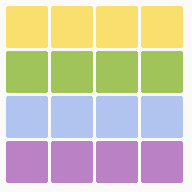
NYT Connections Hints, Answers & Clues -
NYT Connections #1257 Tip
One category here has nothing to do with what the words mean.
What Makes NYT Connections #1257 Tricky?
UNDERGROUND, CORK, BORE, and HOUSING land in the same grid and pull in completely different directions — underground tunnels, wine bottle stoppers, a drilling verb, and what might be a neighbourhood or a phone case.
The editor's deepest trick is one entire category that has nothing to do with what the words mean — it is about the shape of the words themselves, and most players will never think to look there.
Harder than average — two groups are clean and satisfying once you spot the thread, but one word in particular moonlights convincingly in at least two wrong groups, and the structural category will blindside anyone who does not think to check the letters.
Connections Hints for Every Word in the November 19, 2026 Puzzle
UNDERGROUND
Connections hint for UNDERGROUND
Below the surface of the earth — and also a word whose first three letters and last three letters are worth examining closely.
TUNNEL
Connections hint for TUNNEL
A passage dug through earth or rock — one of the most direct ways to make a hole in the ground.
CORD
Connections hint for CORD
The cable that carries electricity from a wall socket to an appliance — not a rope or a musical chord.
CORK
Connections hint for CORK
The spongy bark harvested from cork oak trees — used for wine bottle stoppers because it comes from a tree, not because it stops things.
SWITCH
Connections hint for SWITCH
The component on an electrical appliance you flip to turn it on or off — not a trade or a thin branch.
EINSTEIN
Connections hint for EINSTEIN
The physicist Albert Einstein — and a word whose opening three letters and closing three letters are identical, which is what matters here.
HOTSHOT
Connections hint for HOTSHOT
An informal word for someone impressively skilled or successful — and a word that begins and ends with the same three-letter sequence.
BORE
Connections hint for BORE
To drill or make a hole by rotating — not to make someone bored, and not a past tense of bear.
SAP
Connections hint for SAP
The sugary liquid that flows through the vascular tissue of trees — maple syrup starts as sap, and it comes directly from the tree.
PLUG
Connections hint for PLUG
The component at the end of an electrical cord that you push into a wall socket — not a stopper for a drain or a promotional mention.
WOOD
Connections hint for WOOD
The hard fibrous material that makes up the trunk and branches of a tree — the most literal tree material in the grid.
HOUSING
Connections hint for HOUSING
The outer casing or shell of an electrical appliance that encloses its internal components — not a neighbourhood or accommodation.
DIG
Connections hint for DIG
To break up and move earth with a tool or hands — the most straightforward hole-making word in the grid.
GALANGAL
Connections hint for GALANGAL
A root spice related to ginger — and a word that opens and closes with the same three letters, which is its only role here.
RESIN
Connections hint for RESIN
A sticky substance that oozes from trees and hardens — used in varnishes and adhesives, and it comes from the tree itself.
BURROW
Connections hint for BURROW
To dig a tunnel into the ground, especially as an animal does — a rabbit burrows, and the action makes a hole.
Traps & Misdirects Hints for NYT Connections Puzzle (#1257)
TUNNEL is a passage dug through earth, UNDERGROUND is literally beneath the ground, and BORE means to drill a hole — stacking them as digging words feels airtight. That cluster is a trap. These three words do not all belong to the same group, and at least one of them is doing something completely different in this puzzle.
PLUG and CORK both mean to seal or stop up an opening — a plug in a drain, a cork in a bottle — and both are things you push into a hole. That shared stopper meaning is a dead end here. One of these belongs to an electrical appliance group and the other comes from a tree, so they are in entirely different categories.
SWITCH, CORD, and HOUSING all feel like parts of a device — you flip the switch, pull the cord, and the housing is the outer casing. That reading is strong for two of them but the third word has a competing meaning that might pull it somewhere else entirely. Do not assume all three land in the same group without checking each one carefully.
SAP can mean to drain someone's energy and BORE can mean to make someone tedious — both work as verbs meaning to weaken or dull. That pairing feels clever but it is a coincidence. Each of these words belongs to a different group in this puzzle, and neither is being used in that figurative sense.
Connections Hints for November 19, 2026
Yellow Connections Hints
Yellow Category Hint
Verbs for excavating or making a hole underground
Think: Think: shovel, drill, animal dens
Yellow Category Name
MAKE A HOLE IN THE GROUND
Yellow Category Words
Reveal word 1
BOREReveal word 2
BURROWReveal word 3
DIGReveal word 4
TUNNELGreen Connections Hints
Green Category Hint
Natural substances or materials that come directly from trees
Think: Think: forest harvest, bark, sap
Green Category Name
MATERIALS OBTAINED FROM TREES
Green Category Words
Reveal word 1
CORKReveal word 2
RESINReveal word 3
SAPReveal word 4
WOODBlue Connections Hints
Blue Category Hint
Physical components found on a household electrical appliance
Think: Think: kettle, lamp, toaster parts
Blue Category Name
PARTS OF AN ELECTRICAL APPLIANCE
Blue Category Words
Reveal word 1
CORDReveal word 2
HOUSINGReveal word 3
PLUGReveal word 4
SWITCHPurple Connections Hints
Purple Category Hint
Words whose first three letters are identical to their last three
Think: Think: spelling, not meaning
Purple Category Name
START AND END WITH THE SAME THREE LETTERS
Purple Category Words
Reveal word 1
EINSTEINReveal word 2
GALANGALReveal word 3
HOTSHOTReveal word 4
UNDERGROUNDNYT Connections Answers for November 19, 2026
NYT Connections Answers Explained: November 19, 2026
MAKE A HOLE IN THE GROUND
BORE, BURROW, DIG, and TUNNEL all describe the act of making a hole or passage in the ground — each word captures a slightly different method or context of excavation.
- BORE
- To bore is to make a hole by rotating a drill or auger into the earth — the mechanical, precision sense of hole-making.
- BURROW
- To burrow is to dig a tunnel into the ground the way a rabbit or mole does — the animal instinct sense of excavation.
- DIG
- To dig is the most general term — breaking up and moving earth with a spade, hands, or any tool to create a hole.
- TUNNEL
- To tunnel is to dig a long passage through earth or rock — the word works as both the action and the result.
MATERIALS OBTAINED FROM TREES
CORK, RESIN, SAP, and WOOD are all materials that come directly from trees — harvested from bark, tissue, or the trunk itself.
- CORK
- Cork is the spongy outer bark of the cork oak tree, harvested in sheets — the tree regrows it, making cork a renewable tree material.
- RESIN
- Resin is the sticky substance that seeps from wounds in tree bark and hardens on contact with air — pine trees produce it abundantly.
- SAP
- Sap is the sugary liquid that flows through a tree's vascular system — tapped from maple trees to make syrup, it is the tree's own fluid.
- WOOD
- Wood is the hard fibrous structural material of tree trunks and branches — the most fundamental and literal tree-derived material.
PARTS OF AN ELECTRICAL APPLIANCE
CORD, HOUSING, PLUG, and SWITCH are all physical components you would find on a standard household electrical appliance — each plays a distinct role in how the device is powered or operated.
- CORD
- The cord is the flexible cable that carries electricity from the wall socket to the appliance — the power lead.
- HOUSING
- The housing is the outer casing or shell of an appliance that encloses and protects all the internal components.
- PLUG
- The plug is the component at the end of the cord with metal pins that you push into a wall socket to connect the appliance to power.
- SWITCH
- The switch is the button or lever on an appliance that you operate to turn it on or off — the user's control point.
START AND END WITH THE SAME THREE LETTERS
EINSTEIN, GALANGAL, HOTSHOT, and UNDERGROUND each begin and end with the same three-letter sequence — the category is purely about the shape of the words, not their meanings.
- EINSTEIN
- EINSTEIN starts with EIN and ends with EIN — the famous physicist's name happens to be a perfect palindromic-edge word.
- GALANGAL
- GALANGAL starts with GAL and ends with GAL — a ginger-like spice whose unusual spelling makes this structural trick easy to miss.
- HOTSHOT
- HOTSHOT starts with HOT and ends with HOT — an informal word for a skilled or successful person that wraps neatly around itself.
- UNDERGROUND
- UNDERGROUND starts with UND and ends with UND — the longest word in the grid, and its structural trick is buried deep enough that most players scan right past it.