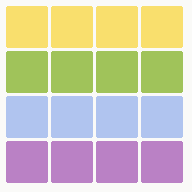
NYT Connections Hints, Answers & Clues -
NYT Connections #1059 Tip
Four words start with something competitive — but look completely innocent.
What Makes NYT Connections #1059 Tricky?
HINT, SUGGESTION, and WHIFF feel like synonyms, BLINK and SHIVER feel like body reactions, and then SHEEPSHANK and GAMELAN sit in the grid looking like they wandered in from completely different encyclopedias.
The editor's main trick is hiding shorter words inside longer ones — some of these 16 words contain a hidden unit from competitive sports or games right at their start, and nothing about the word's surface meaning gives that away.
This one skews hard — two groups are satisfying and quick once you see the thread, but the knots category will fool anyone who doesn't sail, and the hidden-unit category is genuinely devious even after you've been warned.
Connections Hints for Every Word in the May 5, 2026 Puzzle
HINT
Connections hint for HINT
A faint trace or suggestion of something — a hint of colour, a hint of irony. This is its role here.
HITCH
Connections hint for HITCH
Commonly means a snag or problem, but here it is a category of knot used to fasten a rope to a post or ring — not a setback.
POINTER
Connections hint for POINTER
Looks like a helpful tip or a pointing finger, but the puzzle is interested in the first four letters, not the whole word.
HICCUP
Connections hint for HICCUP
An involuntary spasm of the diaphragm that produces a sharp sound — one of the body's most uncontrollable reflexes.
BEND
Connections hint for BEND
Commonly means to curve or flex, but here it is a knot category — a bend joins two rope ends together, not a curve in a road.
SETBACK
Connections hint for SETBACK
Looks like a reversal or obstacle, but the puzzle is interested in the first three letters hidden at its start, not its meaning.
BLINK
Connections hint for BLINK
An involuntary rapid closing and opening of the eyelid — you do it without thinking, which is exactly the point here.
SUGGESTION
Connections hint for SUGGESTION
A faint trace or slight indication of something — a suggestion of a smile, a suggestion of garlic. Synonym territory.
SNEEZE
Connections hint for SNEEZE
An involuntary explosive expulsion of air through the nose and mouth — completely beyond conscious control.
WHIFF
Connections hint for WHIFF
A faint brief smell or trace of something — a whiff of smoke, a whiff of scandal. Sits naturally with HINT and SUGGESTION.
SHIVER
Connections hint for SHIVER
An involuntary trembling of the body, usually from cold or fear — the muscles act without permission.
FLICKER
Connections hint for FLICKER
Commonly means a brief unsteady light or movement, but here it means a faint trace — a flicker of hope, a flicker of recognition.
GAMELAN
Connections hint for GAMELAN
A traditional Indonesian percussion orchestra — but the puzzle cares about the first four letters, which name a unit in a competitive sport.
SHEEPSHANK
Connections hint for SHEEPSHANK
A specific knot used to shorten a length of rope without cutting it — a genuine nautical and climbing term.
MATCHSTICK
Connections hint for MATCHSTICK
A thin stick tipped with a chemical that ignites when struck — but the puzzle cares about the first five letters, which name a unit in a competitive sport.
BOWLINE
Connections hint for BOWLINE
A knot that forms a fixed loop at the end of a rope — one of the most fundamental knots in sailing and rescue work.
Traps & Misdirects Hints for NYT Connections Puzzle (#1059)
At first glance, HINT, POINTER and SUGGESTION all appear to gesture toward an answer without spelling it out. But that reading misses the mark—one of these words is more at home on the scoreboard than in wordplay.
BLINK is an involuntary eye movement and FLICKER is a rapid unsteady movement of light — they both suggest something fast and repetitive, and it is tempting to group them as body-or-motion words. They belong to different categories. FLICKER's role here has nothing to do with movement.
BEND and SNEEZE feel like they belong together as things people do, but that’s a red herring. “Bend” ties into knots, not actions, so this pairing doesn’t hold.
SETBACK and HICCUP appear to point toward minor hindrances, making them an easy pair to group. But that instinct leads nowhere—one of these words is meant quite literally and fits better alongside other involuntary bodily actions.
Connections Hints for May 5, 2026
Yellow Connections Hints
Yellow Category Hint
A faint trace or barely-there indication of something
Think: Think: barely there, almost nothing
Yellow Category Name
GLIMMER
Yellow Category Words
Reveal word 1
FLICKERReveal word 2
HINTReveal word 3
SUGGESTIONReveal word 4
WHIFFGreen Connections Hints
Green Category Hint
Things your body does without asking your permission
Think: Think: reflex, no conscious control
Green Category Name
INVOLUNTARY ACTIONS
Green Category Words
Reveal word 1
BLINKReveal word 2
HICCUPReveal word 3
SHIVERReveal word 4
SNEEZEBlue Connections Hints
Blue Category Hint
Technical terms for specific ways of tying rope
Think: Think: sailing, climbing, rope work
Blue Category Name
KINDS OF KNOTS
Blue Category Words
Reveal word 1
BENDReveal word 2
BOWLINEReveal word 3
HITCHReveal word 4
SHEEPSHANKPurple Connections Hints
Purple Category Hint
Longer words whose first letters spell a competition unit
Think: Think: hidden word, sports scoring
Purple Category Name
STARTING WITH UNITS IN COMPETITIONS
Purple Category Words
Reveal word 1
GAMELANReveal word 2
MATCHSTICKReveal word 3
POINTERReveal word 4
SETBACKNYT Connections Answers for May 5, 2026
NYT Connections Answers Explained: May 5, 2026
GLIMMER
FLICKER, HINT, SUGGESTION, and WHIFF all mean a faint, barely-there trace of something — each word describes the smallest possible amount of a quality, feeling, or sensation.
- FLICKER
- A flicker of hope or a flicker of recognition means the tiniest brief sign of something — the light-and-movement meaning is a decoy.
- HINT
- A hint of garlic or a hint of sadness means a trace so small you almost miss it — the most everyday word in this group.
- SUGGESTION
- A suggestion of a smile or a suggestion of danger means a faint indication, barely enough to register — the same idea as hint but slightly more formal.
- WHIFF
- A whiff of something means a brief faint trace, usually of a smell but also of a quality — a whiff of scandal, a whiff of danger.
INVOLUNTARY ACTIONS
BLINK, HICCUP, SHIVER, and SNEEZE are all things the body does automatically, without conscious decision — reflexes or spasms that happen to you rather than being chosen by you.
- BLINK
- The rapid involuntary closing of the eyelid — you do it thousands of times a day without ever deciding to.
- HICCUP
- An involuntary spasm of the diaphragm that snaps the vocal cords shut and produces a sharp sound — notoriously impossible to stop on command.
- SHIVER
- Rapid involuntary muscle trembling, usually triggered by cold or fear — the body generating heat or reacting to a threat without asking.
- SNEEZE
- An explosive involuntary expulsion of air through the nose and mouth — triggered by irritation, impossible to fully suppress.
KINDS OF KNOTS
BEND, BOWLINE, HITCH, and SHEEPSHANK are all specific categories or named types of knot used in sailing, climbing, and rope work — each describes a distinct technique for tying rope.
- BEND
- In knot terminology a bend is a knot that joins two separate rope ends together — the sheet bend and the reef knot are classic examples.
- BOWLINE
- A knot that creates a fixed non-slipping loop at the end of a rope — essential in sailing and rescue work because the loop holds its size under load.
- HITCH
- A knot used to fasten a rope to a fixed object such as a post, ring, or another rope — the clove hitch and half hitch are common examples.
- SHEEPSHANK
- A knot used to temporarily shorten a length of rope without cutting it — it takes up the slack in the middle of a rope and can be undone easily.
STARTING WITH UNITS IN COMPETITIONS
GAMELAN, MATCHSTICK, POINTER, and SETBACK each begin with a word that names a unit used in competitive sports or games — GAME, MATCH, POINT, and SET are all ways of scoring or structuring a contest.
- GAMELAN
- GAMELAN is a traditional Indonesian percussion ensemble — but it starts with GAME, a unit of competition (as in a game of tennis or a game in a series).
- MATCHSTICK
- MATCHSTICK is a thin wooden stick used to strike a flame — but it starts with MATCH, a unit of competition meaning a single contest between two players or teams.
- POINTER
- POINTER looks like a helpful tip or a breed of dog — but it starts with POINT, the basic unit of scoring in most competitive sports and games.
- SETBACK
- SETBACK means a reversal or obstacle in everyday English — but it starts with SET, a unit of competition used in tennis, volleyball, and similar sports.