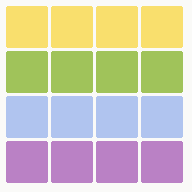
NYT Connections Hints, Answers & Clues -
NYT Connections #1103 Tip
Four words are secretly tools with their last two letters removed.
What Makes NYT Connections #1103 Tricky?
Words like TUTU, PLIE, BARRE, and WREN sit alongside MANDELA, CARRIAGE, and HAMM — a collision of ballet vocabulary, famous surnames, fitness terms, and what might be a bird or a name.
The editor's trick is that four words look like something completely familiar — a ballet move, a bird, a gymnast's name, a tool motion — but are actually common tools with their final two letters quietly removed.
Two groups are fairly accessible once you spot the theme, but the disguised-tools category is genuinely devious and will cost most players at least one mistake.
Connections Hints for Every Word in the June 18, 2026 Puzzle
WREN
Connections hint for WREN
Looks like a small brown bird or the architect Christopher Wren — here it is a common tool with its last two letters removed.
CARRIAGE
Connections hint for CARRIAGE
The way a person holds their body while moving — upright carriage, dignified carriage — not a horse-drawn vehicle.
KING
Connections hint for KING
Martin Luther King Jr. was a towering civil rights leader and Nobel Peace Prize winner — that is the sense in play here.
PLIE
Connections hint for PLIE
Looks like the ballet knee-bend spelled plié — but here it is a common workshop tool with its last two letters stripped off.
BARRE
Connections hint for BARRE
The horizontal rail used in ballet class — and a legitimate fitness class format built around ballet-inspired movements.
BEARING
Connections hint for BEARING
The way a person presents themselves physically — a military bearing, a regal bearing — not a mechanical ball bearing.
TUTU
Connections hint for TUTU
Looks like the layered ballet skirt — but here it is a well-known peace activist, Archbishop Desmond Tutu of South Africa.
ATTITUDE
Connections hint for ATTITUDE
How a person comes across in manner and disposition — their general demeanor toward others.
MANDELA
Connections hint for MANDELA
Nelson Mandela, South African anti-apartheid leader and Nobel Peace Prize winner, imprisoned for 27 years before becoming president.
PRESENCE
Connections hint for PRESENCE
The quality of commanding attention simply by being in a room — stage presence, a powerful presence.
HAMM
Connections hint for HAMM
Looks like the gymnast Mia or Paul Hamm — here it is a striking tool with its last two letters removed.
BOOTCAMP
Connections hint for BOOTCAMP
A high-intensity military-style fitness class — interval training, bodyweight exercises, drill-sergeant energy.
PILATES
Connections hint for PILATES
A fitness method focused on core strength, controlled movement, and alignment — developed by Joseph Pilates.
JIGS
Connections hint for JIGS
Looks like a lively folk dance or the plural of jig — here it is a workshop tool with its last two letters removed.
GANDHI
Connections hint for GANDHI
Mahatma Gandhi, the Indian independence leader who pioneered nonviolent civil disobedience — Nobel Peace Prize nominee.
AEROBICS
Connections hint for AEROBICS
Rhythmic cardiovascular exercise set to music — the classic group fitness class format popularised in the 1980s.
Traps & Misdirects Hints for NYT Connections Puzzle (#1103)
TUTU is the skirt a ballerina wears, PLIE is a fundamental ballet knee-bend, and BARRE is the rail dancers hold during warm-up — grouping these three as ballet terms feels completely natural. That reading is a dead end. Each of these words belongs to a different group in this puzzle, and their ballet meanings are the decoy.
KING, WREN, and HAMM all look like famous surnames — a civil rights leader, a British monarch's architect, a gymnast — and it is tempting to cluster them as notable people. That surface association does not hold up here. These three words belong to different groups, and at least one of them is hiding a completely different identity.
CARRIAGE, BEARING, and PRESENCE all describe how a person carries themselves — their posture, their air, their effect on a room — and pulling them together as a group feels satisfying. Be careful: there is a fourth word in the grid that shares this meaning, and one of these three may be pulling double duty elsewhere.
Connections Hints for June 18, 2026
Yellow Connections Hints
Yellow Category Hint
Group exercise formats you would find on a gym timetable
Think: Think: studio schedule, instructor-led classes
Yellow Category Name
FITNESS CLASS TYPES
Yellow Category Words
Reveal word 1
AEROBICSReveal word 2
BARREReveal word 3
BOOTCAMPReveal word 4
PILATESGreen Connections Hints
Green Category Hint
Words describing how a person carries themselves in manner
Think: Think: posture, air, composure
Green Category Name
DEMEANOR
Green Category Words
Reveal word 1
ATTITUDEReveal word 2
BEARINGReveal word 3
CARRIAGEReveal word 4
PRESENCEBlue Connections Hints
Blue Category Hint
Figures celebrated globally for nonviolent activism and peace
Think: Think: Nobel Prize, civil rights, justice
Blue Category Name
PEACE ACTIVISTS
Blue Category Words
Reveal word 1
GANDHIReveal word 2
KINGReveal word 3
MANDELAReveal word 4
TUTUPurple Connections Hints
Purple Category Hint
Familiar workshop tools with their last two letters deleted
Think: Think: add two letters back
Purple Category Name
TOOLS MINUS LAST TWO LETTERS
Purple Category Words
Reveal word 1
HAMMReveal word 2
JIGSReveal word 3
PLIEReveal word 4
WRENNYT Connections Answers for June 18, 2026
NYT Connections Answers Explained: June 18, 2026
FITNESS CLASS TYPES
AEROBICS, BARRE, BOOTCAMP, and PILATES are all named formats for group fitness classes — the kind listed on a gym or studio timetable with an instructor.
- AEROBICS
- Rhythmic cardiovascular exercise set to music — the original group fitness class, popularised in the 1980s and still widely offered.
- BARRE
- A fitness class inspired by ballet training, using the barre rail and ballet-derived movements to build strength and flexibility.
- BOOTCAMP
- A high-intensity class modelled on military training — circuits, bodyweight drills, and minimal rest, designed to push participants hard.
- PILATES
- A method developed by Joseph Pilates focusing on core strength, controlled breathing, and precise alignment — offered as a class in most gyms.
DEMEANOR
ATTITUDE, BEARING, CARRIAGE, and PRESENCE all describe the overall impression a person projects through their manner, posture, and way of occupying a space.
- ATTITUDE
- A person's general manner and disposition toward others — their attitude in a room tells you a great deal about them before they speak.
- BEARING
- The way a person holds and carries their body — a soldier's upright bearing, a queen's dignified bearing.
- CARRIAGE
- The manner in which a person holds themselves while moving — elegant carriage, proud carriage — nothing to do with horse-drawn vehicles here.
- PRESENCE
- The quality of commanding attention simply by being somewhere — stage presence, a powerful presence — an almost intangible aspect of demeanor.
PEACE ACTIVISTS
GANDHI, KING, MANDELA, and TUTU are four of the most celebrated figures in the history of nonviolent activism — each fought for justice and human dignity through peaceful means.
- GANDHI
- Mahatma Gandhi led India's independence movement through nonviolent civil disobedience and is considered the father of modern peaceful protest.
- KING
- Martin Luther King Jr. led the American civil rights movement in the 1950s and 60s, winning the Nobel Peace Prize in 1964 for his nonviolent campaigns.
- MANDELA
- Nelson Mandela spent 27 years imprisoned for opposing South African apartheid, then led the country's peaceful transition to democracy and won the Nobel Peace Prize in 1993.
- TUTU
- Archbishop Desmond Tutu was a South African anti-apartheid activist and Nobel Peace Prize laureate — his surname looks like a ballet skirt, which is the trap.
TOOLS MINUS LAST TWO LETTERS
HAMM, JIGS, PLIE, and WREN are each a common workshop or hand tool with its final two letters removed — add the letters back and the tool appears.
- HAMM
- HAMM + ER = HAMMER — the most fundamental striking tool, used to drive nails. The double-M ending disguises it well.
- JIGS
- JIGS + AW = JIGSAW — the power tool used for cutting curves and irregular shapes in wood. JIGS alone looks like a dance or a verb.
- PLIE
- PLIE + RS = PLIERS — the gripping hand tool used to hold, bend, or cut wire and small objects. It looks exactly like the ballet term plié, which is the deliberate misdirect.
- WREN
- WREN + CH = WRENCH — the tool used to tighten or loosen nuts and bolts. It looks like the small bird or the surname, hiding the tool completely.