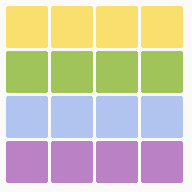
NYT Connections Hints, Answers & Clues -
NYT Connections #1242 Tip
IRON pulls double duty, and one category hides in plain sight.
What Makes NYT Connections #1242 Tricky?
IRON, POKE, WEDGE, and FLY sit in this grid looking like they belong to completely different worlds — a household chore, a jab, a door prop, and something airborne — yet the puzzle uses none of them the way you'd expect.
The editor's main trick is loading the grid with words that have strong, obvious meanings that are all wrong — your first instinct about what connects them will almost certainly be a dead end.
Moderate difficulty overall — one group should click quickly once you spot the theme, but the compound-word category is genuinely sneaky because the connecting piece is invisible on the grid.
Connections Hints for Every Word in the November 4, 2026 Puzzle
FLY
Connections hint for FLY
Not the insect or the verb — think of what word it completes when something else comes before it.
POKE
Connections hint for POKE
Not jabbing something — here it means to move slowly and aimlessly, as in poking around the house.
IRON
Connections hint for IRON
The laundry appliance you press shirts with — and the care label tells you whether you can use it.
WORKS
Connections hint for WORKS
Not a factory or a verb — think of what word turns this into a spectacular display.
WOOD
Connections hint for WOOD
Not timber in general — think of what single word in front of it creates something you burn in a fireplace.
WRING
Connections hint for WRING
To twist wet fabric to squeeze out water — care labels warn against this to protect delicate fibres.
WEDGE
Connections hint for WEDGE
A triangular solid with a sharp leading edge — think doorstops, cheese slices, and famous buildings.
BLEACH
Connections hint for BLEACH
A chemical that whitens fabric — care labels warn against it when a garment's colour or fibres can't handle it.
PUTTER
Connections hint for PUTTER
Not the golf club — to putter around means to occupy yourself with small, aimless tasks.
CRACKER
Connections hint for CRACKER
Not the snack — think of what word in front of it describes something that bangs and sparks.
DOORSTOP
Connections hint for DOORSTOP
The wedge-shaped block that holds a door open — its triangular cross-section gives it a sharp bottom edge.
LOLL
Connections hint for LOLL
To lounge or droop lazily — lolling around means doing very little with no particular purpose.
FLATIRON BUILDING
Connections hint for FLATIRON BUILDING
The famous New York skyscraper with a razor-thin triangular footprint — named for its resemblance to a clothes iron, but here it is about its shape.
SHUFFLE
Connections hint for SHUFFLE
Not cards or a dance move — to shuffle around means to move slowly and without direction.
TUMBLE DRY
Connections hint for TUMBLE DRY
The machine-drying cycle that tumbles clothes in heat — care labels warn against it for items that shrink or warp.
PIE SLICE
Connections hint for PIE SLICE
A triangular wedge cut from a round pie — it has a pointed tip and two straight sides meeting at an angle.
Traps & Misdirects Hints for NYT Connections Puzzle (#1242)
IRON and FLATIRON BUILDING both contain the word iron, and the Flatiron Building is famously named for its iron-shaped triangular footprint — so grouping them together feels airtight. That connection is a red herring. These two words belong to completely different categories, and only one of them is about the iron you press clothes with.
POKE suggests poking a fire, WEDGE suggests a doorstop or physical shape, and SHUFFLE suggests moving cards or feet — all three feel like physical actions or objects with no common thread. The puzzle uses each of them in a much more specific, idiomatic sense. None of them are here for their most obvious meaning.
FLY, CRACKER, and WORKS each look like standalone words with their own meanings — a flying insect, a snack, a factory. The puzzle treats them as word fragments, not complete words. If you are reading them as independent nouns or verbs, you are looking at them the wrong way.
Connections Hints for November 4, 2026
Yellow Connections Hints
Yellow Category Hint
Real-world objects that taper to a sharp triangular edge
Think: Think: geometry, pointed tip, prism
Yellow Category Name
TRIANGULAR PRISMS WITH A SHARP EDGE
Yellow Category Words
Reveal word 1
DOORSTOPReveal word 2
FLATIRON BUILDINGReveal word 3
PIE SLICEReveal word 4
WEDGEGreen Connections Hints
Green Category Hint
Instructions printed on clothing tags telling you what to avoid
Think: Think: laundry, fabric care, warnings
Green Category Name
WORDS AFTER "DO NOT" ON A CARE LABEL
Green Category Words
Reveal word 1
BLEACHReveal word 2
IRONReveal word 3
TUMBLE DRYReveal word 4
WRINGBlue Connections Hints
Blue Category Hint
Verbs meaning to move or hang about aimlessly, paired with 'around'
Think: Think: idle, wander, no destination
Blue Category Name
MOVE IDLY, WITH "AROUND"
Blue Category Words
Reveal word 1
LOLLReveal word 2
POKEReveal word 3
PUTTERReveal word 4
SHUFFLEPurple Connections Hints
Purple Category Hint
Each becomes a new compound word when the same word leads it
Think: Think: one word, four completions
Purple Category Name
FIRE___
Purple Category Words
Reveal word 1
CRACKERReveal word 2
FLYReveal word 3
WOODReveal word 4
WORKSNYT Connections Answers for November 4, 2026
NYT Connections Answers Explained: November 4, 2026
TRIANGULAR PRISMS WITH A SHARP EDGE
DOORSTOP, FLATIRON BUILDING, PIE SLICE, and WEDGE are all real-world objects whose shape is essentially a triangular prism — wide at one end and tapering to a sharp edge or point.
- DOORSTOP
- The classic rubber or wooden doorstop is a wedge shape — a triangular prism with a thin leading edge that slides under a door.
- FLATIRON BUILDING
- The famous New York skyscraper built in 1902 has a razor-thin triangular footprint, like a flatiron or a ship's prow — a triangular prism rising 22 storeys.
- PIE SLICE
- A slice cut from a round pie is a triangular wedge in cross-section — pointed at the tip, wide at the crust end, with straight sides.
- WEDGE
- The wedge is the defining shape of this category — a triangular prism that is the template all the others are compared to.
WORDS AFTER 'DO NOT' ON A CARE LABEL
BLEACH, IRON, TUMBLE DRY, and WRING are the four instructions you find on clothing care labels prefixed with 'Do Not' — each warns against a specific laundry action that could damage the garment.
- BLEACH
- 'Do not bleach' appears on care labels when a fabric's colour or fibres cannot withstand chlorine or oxygen bleach.
- IRON
- 'Do not iron' warns that the fabric will scorch, melt, or lose its texture if you press it with a hot iron — this is the laundry sense, not the metal.
- TUMBLE DRY
- 'Do not tumble dry' means the item must not go in a machine dryer — tumbling in heat causes shrinkage or warping in many fabrics.
- WRING
- 'Do not wring' means do not twist the wet fabric to squeeze out water — wringing can stretch or tear delicate fibres.
MOVE IDLY, WITH 'AROUND'
LOLL, POKE, PUTTER, and SHUFFLE all work as verbs meaning to move or occupy oneself aimlessly when followed by 'around' — loll around, poke around, putter around, shuffle around.
- LOLL
- To loll around means to lounge or droop lazily with no purpose — lolling around the house on a Sunday.
- POKE
- To poke around means to move slowly and nosily through a space — poking around in the attic looking for nothing in particular.
- PUTTER
- To putter around means to busy yourself with small, aimless tasks — pottering is the British equivalent, and both mean the same idle drifting.
- SHUFFLE
- To shuffle around means to move slowly and without energy or direction — shuffling around the kitchen in slippers.
FIRE___
CRACKER, FLY, WOOD, and WORKS each form a compound word or phrase when FIRE is placed in front — firecracker, firefly, firewood, and fireworks.
- CRACKER
- A firecracker is a small explosive device that makes a loud bang — a staple of celebrations and the word that most obviously signals this category.
- FLY
- A firefly is the bioluminescent insect that glows in the dark — the compound word is one of the most familiar in the English language.
- WOOD
- Firewood is wood cut and dried specifically for burning in a fireplace or campfire — a completely standard compound noun.
- WORKS
- Fireworks are the explosive aerial displays used in celebrations — the plural form is far more common than the singular, but WORKS is the piece the puzzle gives you.