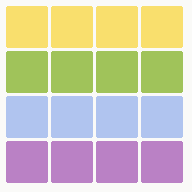
NYT Connections Hints, Answers & Clues -
NYT Connections #1079 Tip
Three letters can mean a machine, a body part, or a goodbye.
What Makes NYT Connections #1079 Tricky?
Words like BALL, LID, BROW, and CAP look like a random collection of body-adjacent nouns, while SCRAP, SHRED, and SPOT feel like they belong to completely different conversations, and ATM sits there looking like it only means one thing.
The editor's main trick is that four words are not standalone answers — they are the second half of a compound word, and nothing about how they appear on the grid signals that.
This one is gentler than average for a Monday — one group should click almost immediately, one requires you to think in compound words, and the abbreviations group is the sneakiest because those three-letter strings all have perfectly innocent non-abbreviation meanings.
Connections Hints for Every Word in the May 25, 2026 Puzzle
BROW
Connections hint for BROW
Your forehead or eyebrow — but here it is being used as the second part of a two-word compound, not as a standalone body part.
CAP
Connections hint for CAP
A hat you might get free at a conference — here it is swag, the kind of branded merchandise handed out at events.
LID
Connections hint for LID
Usually a cover for a pot or a jar — here it completes a compound word when you put EYE in front of it.
CYA
Connections hint for CYA
Texting shorthand for see you around or see you later — a casual sign-off in a message.
WHIT
Connections hint for WHIT
A very small amount — not a common standalone word, but the phrase 'not one whit' means not even the tiniest bit.
ATM
Connections hint for ATM
Usually means the cash machine on the corner — but in texting it means at the moment, as in 'busy ATM'.
PIN
Connections hint for PIN
A small badge or button you clip to a bag or jacket — a classic piece of branded swag at events and conferences.
SPOT
Connections hint for SPOT
Usually a location or a mark — here it means a tiny amount, as in 'a spot of trouble' or 'not a spot of evidence'.
LASH
Connections hint for LASH
Your eyelash — and it completes a compound word when EYE comes before it.
LOL
Connections hint for LOL
Laugh out loud — one of the most recognised texting abbreviations, used to signal something is funny.
SCRAP
Connections hint for SCRAP
Usually means to fight or to throw something away — here it means a tiny fragment or remnant, as in 'not a scrap of evidence'.
SHIRT
Connections hint for SHIRT
A branded T-shirt or polo — the most common piece of swag handed out at events, trade shows, and conferences.
STICKER
Connections hint for STICKER
A peel-and-stick label with a logo or design — a cheap and popular swag item at conventions and brand activations.
BALL
Connections hint for BALL
Usually a round object for sport — here it completes a compound word when EYE comes before it, giving you eyeball.
TIA
Connections hint for TIA
Texting shorthand for thanks in advance — used at the end of a request message.
SHRED
Connections hint for SHRED
Usually means to tear or destroy documents — here it means a tiny piece or amount, as in 'not a shred of doubt'.
Traps & Misdirects Hints for NYT Connections Puzzle (#1079)
CAP is something you put on your head, LID is a cover that goes on top of something, and BROW is your forehead — all three feel like they belong to the same head-and-covering cluster. That surface connection is a dead end. These three words belong to three different categories and share nothing in this puzzle.
ATM and PIN may instantly seem connected since a PIN is required to access an ATM, but none of the other words in the grid reinforce this banking-related theme, making the grouping a misleading dead end.
Connections Hints for May 25, 2026
Yellow Connections Hints
Yellow Category Hint
Four words all meaning a very small amount of something
Think: Think: not even ___ of evidence
Yellow Category Name
TINY BIT
Yellow Category Words
Reveal word 1
SCRAPReveal word 2
SHREDReveal word 3
SPOTReveal word 4
WHITGreen Connections Hints
Green Category Hint
Branded freebies you collect at events and conferences
Think: Think: tote bag, booth giveaway
Green Category Name
COMMON SWAG ITEMS
Green Category Words
Reveal word 1
CAPReveal word 2
PINReveal word 3
SHIRTReveal word 4
STICKERBlue Connections Hints
Blue Category Hint
Three-letter shortcuts used in text messages
Think: Think: phone keyboard, quick replies
Blue Category Name
TEXTING ABBREVIATIONS
Blue Category Words
Reveal word 1
ATMReveal word 2
CYAReveal word 3
LOLReveal word 4
TIAPurple Connections Hints
Purple Category Hint
Words that follow a single body part to make a new compound word
Think: Think: one word, four completions
Purple Category Name
EYE___
Purple Category Words
Reveal word 1
BALLReveal word 2
BROWReveal word 3
LASHReveal word 4
LIDNYT Connections Answers for May 25, 2026
NYT Connections Answers Explained: May 25, 2026
TINY BIT
SCRAP, SHRED, SPOT, and WHIT all mean a very small amount or fragment of something — each is used in phrases like 'not a scrap of evidence' or 'not one whit of difference' to emphasise how little there is.
- SCRAP
- A scrap means a tiny fragment — 'not a scrap of truth' means there is absolutely none, which is the sense the puzzle uses rather than fighting or discarding.
- SHRED
- A shred is a thin torn piece — 'not a shred of doubt' means zero doubt, using the word to mean the smallest possible amount.
- SPOT
- A spot can mean a small amount in British English — 'a spot of bother' or 'not a spot of evidence' uses it to mean a tiny bit.
- WHIT
- A whit is an old-fashioned word for the smallest imaginable amount — 'not one whit' means not even the tiniest bit, and it almost always appears in negative phrases like this.
COMMON SWAG ITEMS
CAP, PIN, SHIRT, and STICKER are all classic pieces of branded merchandise — the kind of free items handed out at conferences, trade shows, and promotional events.
- CAP
- A branded baseball cap is one of the most recognisable swag items — companies print their logo on the front and hand them out at events.
- PIN
- A small enamel or metal pin badge is a popular collectible swag item, often given out at conventions, brand launches, and fan events.
- SHIRT
- A branded T-shirt or polo shirt is the most common swag item of all — almost every conference, charity run, or product launch produces one.
- STICKER
- A logo sticker is cheap to produce and easy to hand out — a staple of tech conferences, indie brands, and convention booths.
TEXTING ABBREVIATIONS
ATM, CYA, LOL, and TIA are all shorthand abbreviations used in text messages and online chat — each compresses a common phrase into three letters.
- ATM
- ATM stands for at the moment in texting — 'busy ATM' means busy right now, which is the reading the puzzle uses rather than the cash machine.
- CYA
- CYA stands for see you around or see you later — a casual sign-off used at the end of a text conversation.
- LOL
- LOL stands for laugh out loud — one of the earliest and most widely recognised texting abbreviations, used to signal amusement.
- TIA
- TIA stands for thanks in advance — typically used at the end of a request message to pre-emptively thank the recipient.
EYE___
BALL, BROW, LASH, and LID all complete a compound word when EYE is placed in front of them — eyeball, eyebrow, eyelash, and eyelid are all parts of or around the eye.
- BALL
- EYEBALL is the entire spherical organ of sight — the word BALL on its own looks like it belongs to sport, which is the misdirect.
- BROW
- EYEBROW is the ridge of hair above the eye — BROW alone means forehead, which makes it look like a standalone body-part word rather than half of a compound.
- LASH
- EYELASH is one of the small hairs that line the edge of the eyelid — LASH alone can mean a whip stroke, so the compound reading is not the first one that comes to mind.
- LID
- EYELID is the fold of skin that closes over the eye — LID alone most commonly means a cover for a container, which is the misleading surface reading.