NYT Connections Hints, Answers & Clues -
NYT Connections #1046 Tip
Four ordinary words transform completely when you say them as proper nouns.
What Makes NYT Connections #1046 Tricky?
SLUG, DECK, PUNCH, and SOCK look like a brawl waiting to happen, WHEEL and CLAY suggest a craft studio, and then NICE, HERB, and READING sit there looking like perfectly innocent vocabulary — the grid pulls you in four directions at once.
The editor's sharpest trick is using words that every English speaker knows cold, then asking you to hear them as a French city, a name, or a British town — the same letters, a completely different sound and meaning.
Hard overall — one group will snap into place fast, one requires you to think about pronunciation rather than meaning, and the remaining two share enough surface overlap to cost you a mistake if you rush.
Connections Hints for Every Word in the April 22, 2026 Puzzle
TRUCK
Connections hint for TRUCK
A large vehicle — but here the puzzle wants the word that follows PICK-UP, not the vehicle itself.
POLISH
Connections hint for POLISH
Usually means to buff something to a shine, or relating to Poland — but said as a proper noun with a different stress, it becomes a city name.
NICE
Connections hint for NICE
Looks like the adjective meaning pleasant, but here it is a city on the French Riviera — pronounced NIECE, not NICE.
SLUG
Connections hint for SLUG
Can mean to hit hard, a garden pest, or a unit of measure — its role here depends on which group you place it in.
DECK
Connections hint for DECK
To deck someone means to punch them — a vivid informal verb for a hard hit.
GAME
Connections hint for GAME
Usually a sport or activity — here it follows PICK-UP, as in pick-up game, the informal version of a sport played without teams.
WHEEL
Connections hint for WHEEL
The spinning disc a potter uses to shape clay — a core piece of pottery equipment.
HERB
Connections hint for HERB
In British English pronounced with a hard H, it is a cooking plant — in American English the H is silent, but as a proper noun it is a man's name pronounced with the H dropped entirely.
CLAY
Connections hint for CLAY
The raw earthy material a potter shapes — the starting point of any ceramic piece.
SOCK
Connections hint for SOCK
To sock someone means to hit them hard — but a sock is also a piece of clothing, which is not what is happening here.
READING
Connections hint for READING
Looks like the present participle of read — but as a proper noun it is a town in England pronounced REDDING, not REEDING.
ARTIST
Connections hint for ARTIST
Someone who makes art — but PICK-UP ARTIST is a specific term for someone who uses rehearsed techniques to meet people romantically.
STICKS
Connections hint for STICKS
Thin pieces of wood — but PICK-UP STICKS is a classic children's game where you drop a bundle and retrieve them one by one without disturbing the others.
GLAZE
Connections hint for GLAZE
The liquid coating applied to pottery before firing that gives ceramics their smooth, shiny finish.
PUNCH
Connections hint for PUNCH
To strike with a fist — one of the most direct words for hitting in English.
KILN
Connections hint for KILN
The high-temperature oven used to fire pottery and harden clay into ceramic.
Traps & Misdirects Hints for NYT Connections Puzzle (#1046)
SLUG is what you do to someone in a fight, PUNCH is the classic hit, and SOCK means to strike hard — all three feel like synonyms for hitting. That instinct is right for some of them but wrong for at least one. Not every word in this cluster belongs to the same group, and one of them has a completely different life outside the context of violence.
DECK means to punch someone squarely, and SLUG means to hit hard — both are vivid informal verbs for striking. They do belong to the same group, but the temptation is to stop there and assume PUNCH and SOCK complete the set without checking whether any of those four words might belong somewhere else entirely.
NICE looks like an adjective meaning pleasant, HERB looks like a cooking ingredient, and READING looks like what you do with a book — all three feel like ordinary common English words. None of them are being used that way here. Each one has a proper noun identity with a different pronunciation that is the actual point.
GAME could mean a sport or competition, STICKS are wooden rods, and ARTIST is someone who makes art — nothing obvious connects them until you realise the puzzle is asking you to put the same two words in front of all three. The connection is not what these words mean on their own.
Connections Hints for April 22, 2026
Yellow Connections Hints
Yellow Category Hint
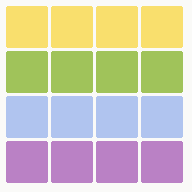
Tools and materials found in a ceramics studio
Think: Think: firing, shaping, coating
Yellow Category Name
POTTERY EQUIPMENT
Yellow Category Words
Reveal word 1
CLAYReveal word 2
GLAZEReveal word 3
KILNReveal word 4
WHEELGreen Connections Hints
Green Category Hint
Informal verbs all meaning to hit someone hard
Think: Think: brawl, strike, thump
Green Category Name
WALLOP
Green Category Words
Reveal word 1
DECKReveal word 2
PUNCHReveal word 3
SLUGReveal word 4
SOCKBlue Connections Hints
Blue Category Hint
Common words that become proper nouns when pronounced differently
Think: Think: city, name, town
Blue Category Name
WORDS PRONOUNCED DIFFERENT WAYS AS PROPER NOUNS
Blue Category Words
Reveal word 1
HERBReveal word 2
NICEReveal word 3
POLISHReveal word 4
READINGPurple Connections Hints
Purple Category Hint
Two words that complete a familiar compound phrase with the same prefix
Think: Think: what comes after PICK-UP
Purple Category Name
PICK-UP ___
Purple Category Words
Reveal word 1
ARTISTReveal word 2
GAMEReveal word 3
STICKSReveal word 4
TRUCKNYT Connections Answers for April 22, 2026
NYT Connections Answers Explained: April 22, 2026
POTTERY EQUIPMENT
CLAY, GLAZE, KILN, and WHEEL are all things you find in a pottery studio — the raw material, the coating, the oven, and the spinning tool that shapes everything.
- CLAY
- The raw earthy material that potters start with — dug from the ground and shaped before firing.
- GLAZE
- A liquid coating brushed onto pottery before the final firing — it melts in the kiln to create a smooth, often shiny surface.
- KILN
- A high-temperature oven that fires pottery, hardening the clay and setting the glaze permanently.
- WHEEL
- The spinning disc a potter sits at to shape clay by hand — the iconic image of the craft.
WALLOP
DECK, PUNCH, SLUG, and SOCK are all informal verbs meaning to hit someone hard — each one a different flavour of the same violent action.
- DECK
- To deck someone is to punch them so hard they fall down — a vivid informal British and American term for a knockout blow.
- PUNCH
- The most direct word in the group — to strike with a closed fist, no ambiguity.
- SLUG
- To slug someone is to hit them with full force — often used for a heavy, swinging blow.
- SOCK
- To sock someone means to hit them hard — the phrase sock it to me captures the same energy.
WORDS PRONOUNCED DIFFERENT WAYS AS PROPER NOUNS
HERB, NICE, POLISH, and READING are all ordinary English words that transform in pronunciation when used as proper nouns — a name, a French city, a nationality, and a British town.
- HERB
- As a common noun it is a cooking plant — pronounced URB in American English or HERB in British English. As a proper noun it is a man's name, pronounced with the H silent: URB.
- NICE
- As a common adjective it means pleasant, pronounced to rhyme with rice. As a proper noun it is a city on the French Riviera, pronounced NIECE.
- POLISH
- As a common verb or adjective it means to buff or relating to shine, stressed on the first syllable: POL-ish. As a proper noun referring to the people or language of Poland, it is also spelled Polish — but the puzzle flags that the stress and context shift entirely.
- READING
- As a common word it is the present participle of read, pronounced REEDING. As a proper noun it is a large town in Berkshire, England, pronounced REDDING — a classic British place-name trap.
PICK-UP ___
ARTIST, GAME, STICKS, and TRUCK all follow the word PICK-UP to form familiar compound phrases — a pick-up artist, a pick-up game, pick-up sticks, and a pick-up truck.
- ARTIST
- A pick-up artist is someone who uses practised social techniques to meet and attract romantic partners — the term has a specific cultural meaning beyond just being an artist.
- GAME
- A pick-up game is an informal, spontaneous game of a sport — basketball and football pick-up games are organised on the spot with whoever shows up.
- STICKS
- Pick-up sticks is a children's game where a bundle of thin sticks is dropped in a pile and players take turns removing one at a time without moving the others.
- TRUCK
- A pick-up truck is a vehicle with an open cargo bed at the back — one of the most common vehicle types in North America.